


FOODCHEM

We're here to help
For product information and pricing, chat with sales agent:

Share:

News
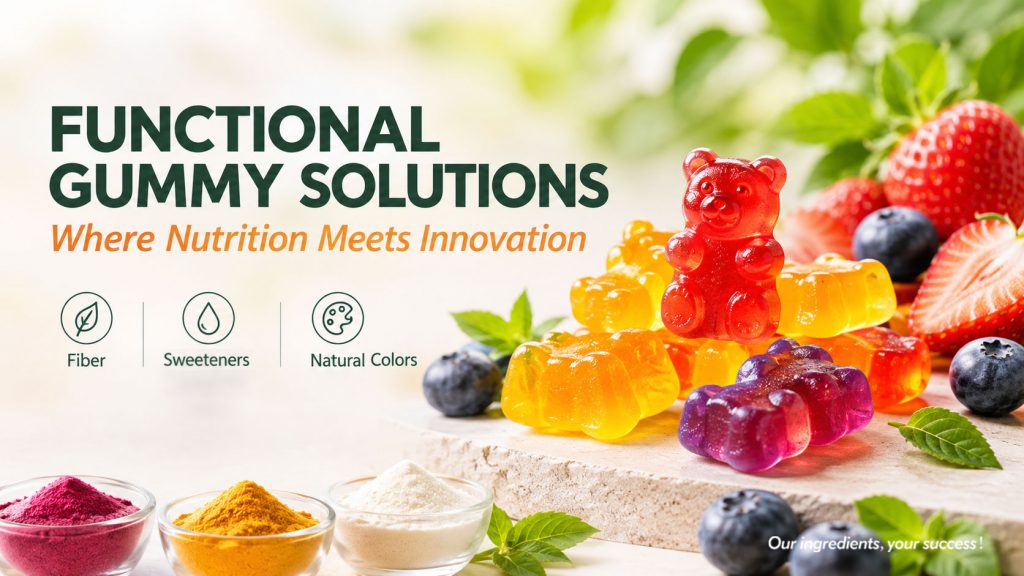
Functional Gummy Solutions: Combining Dietary Fiber, Natural Sweeteners & Natural Colors
How the right combination of functional ingredients can help manufacturers develop innovative gummies for the growing health and wellness market.
The global demand for functional foods and dietary supplements is creating new opportunities for gummy products. Once primarily associated with confectionery, gummies have evolved into a popular delivery format for vitamins, minerals, botanical extracts, fiber, and other functional ingredients.
For food and supplement manufacturers, developing a successful functional gummy requires more than selecting active ingredients. Formulation must balance nutritional value, sweetness, texture, appearance, processing stability, and consumer appeal.
Three ingredient categories play an important role in this process: dietary fibers, natural sweeteners, and natural colors.
By combining these ingredients with suitable gelling systems and functional components, manufacturers can develop differentiated gummy products for gut health, daily nutrition, beauty, and general wellness applications.
1. Why Are Functional Gummies Gaining Attention?
Functional gummies offer a convenient and enjoyable alternative to traditional tablets, capsules, and powdered supplements.
Their flexible formulations allow manufacturers to incorporate multiple ingredients into a single product while offering a wide range of flavors, colors, shapes, and textures.
Popular functional gummy applications include:
- Fiber Gummies: Products formulated with dietary fibers for daily fiber intake.
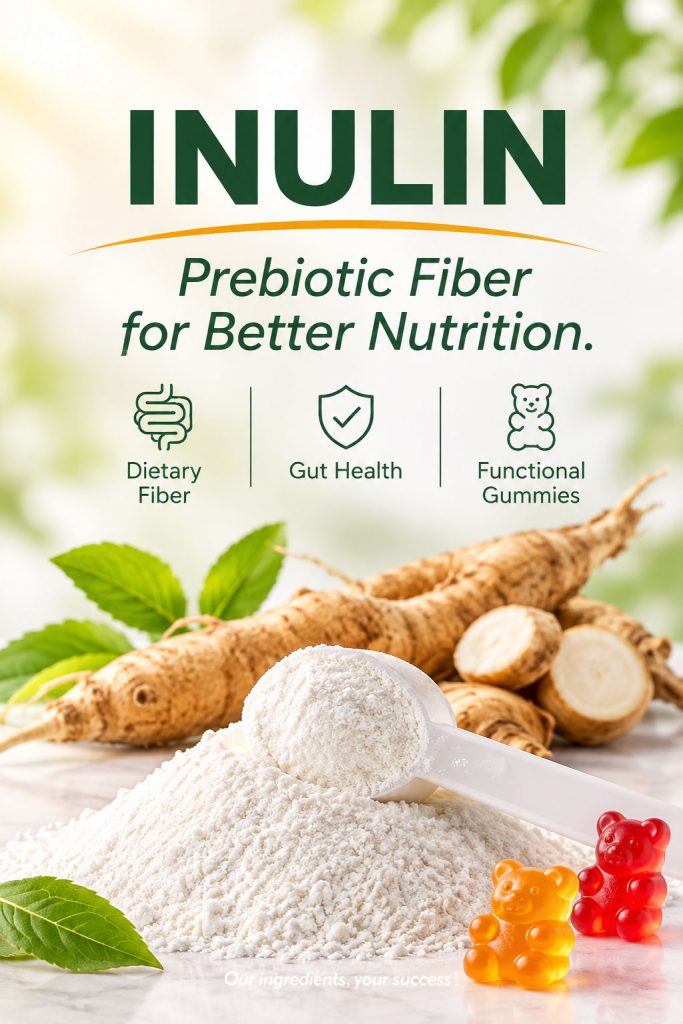
- Prebiotic Gummies: Formulations featuring ingredients such as inulin and fructooligosaccharides (FOS).
- Gut Health Gummies: Products combining selected fibers and other digestive wellness ingredients.
- Beauty Gummies: Formulations featuring collagen, vitamins, and other beauty-oriented ingredients.
- Daily Wellness Gummies: Products containing vitamins, minerals, and selected functional ingredients.
As consumer preferences evolve, manufacturers are also exploring reduced-sugar formulations, plant-based alternatives, and products featuring naturally derived colors.
This creates new formulation opportunities for ingredient suppliers and gummy manufacturers.
2. Dietary Fiber: The Foundation of Fiber and Prebiotic Gummies
Dietary fiber is an important ingredient category for manufacturers developing fiber-enriched foods and functional supplements.
In gummy formulations, selected soluble fibers can help increase fiber content while contributing to the overall formulation structure and product characteristics.
Key dietary fiber ingredients include:
| Ingredient | Key Characteristics | Potential Gummy Applications |
|---|---|---|
| Inulin | Soluble fiber with prebiotic properties | Fiber Gummies, Prebiotic Gummies |
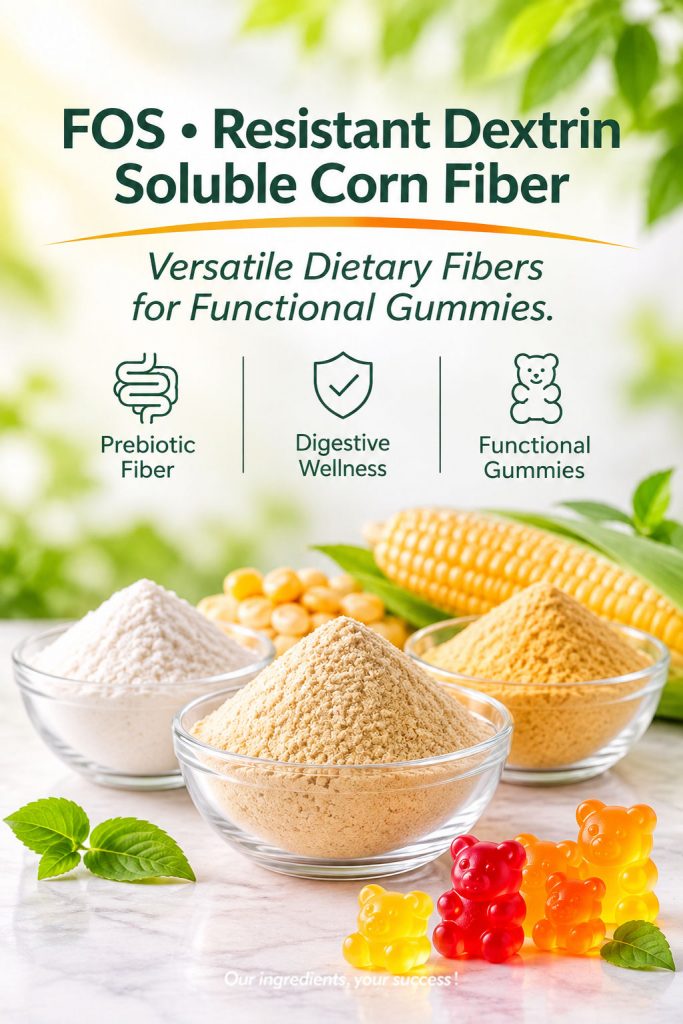
| Fructooligosaccharides (FOS) | Prebiotic carbohydrate | Gut Health Gummies, Fiber Gummies |
| Resistant Dextrin | Highly versatile soluble fiber | Fiber-Enriched Gummies |
| Soluble Corn Fiber | Soluble fiber used in reduced-sugar and fiber-enriched formulations | Functional Gummies |
| Acacia Fiber | Soluble dietary fiber with useful formulation properties | Prebiotic Gummies |
| Psyllium Husk | Fiber ingredient with strong water-binding properties | Specialized Fiber Supplements |
How to Select the Right Fiber for Gummies
Not every dietary fiber performs equally well in gummy production.
Manufacturers should consider:
- Solubility: Whether the fiber dissolves or disperses effectively in the gummy base.
- Viscosity: How it affects the processing and depositing stages.
- Texture: Whether it changes firmness, elasticity, or chewiness.
- Taste: Whether it introduces unwanted flavors or affects sweetness.
- Processing Stability: How it performs under the required temperature and pH conditions.
- Fiber Content: How much dietary fiber can be incorporated while maintaining acceptable product quality.
Inulin, FOS, resistant dextrin, and soluble corn fiber are useful starting points for exploring fiber-enriched gummy formulations. Final selection should be based on application testing and the intended nutritional labeling requirements.
3. Natural Sweeteners: Creating Better-Tasting Reduced-Sugar Gummies
Sweetness is one of the most important factors influencing consumer acceptance of functional gummies.
However, conventional gummy formulations often rely on significant amounts of sugar or glucose syrup to achieve their characteristic sweetness, texture, and structure.
Manufacturers looking to develop reduced-sugar or sugar-free products need to consider alternative sweetening systems that deliver an appropriate sweetness profile without compromising texture and processing performance.
Key Sweetener Ingredients for Functional Gummies
High-Intensity Natural Sweeteners
- Stevia Extract: A plant-derived high-intensity sweetener used in reduced-sugar formulations.
- Monk Fruit Extract: A plant-derived sweetener containing mogrosides, suitable for selected reduced-sugar applications.
- Thaumatin: A high-intensity sweet protein used as a sweetening and flavor-modifying ingredient.
Alternative Sweetening Ingredients
- Allulose: A low-calorie sweetening ingredient that provides sweetness and useful formulation properties.
- Erythritol: A sugar alcohol commonly used in reduced-sugar confectionery.
- Xylitol: A sugar alcohol with a sweetness profile similar to sucrose.
- Maltitol: A bulk sweetener used in confectionery and sugar-reduced products.
What Should Manufacturers Consider?
Choosing a sweetener for gummies involves more than comparing sweetness intensity.
Important formulation considerations include:
- Sweetness intensity and taste profile.
- Aftertaste and flavor compatibility.
- Solubility and crystallization behavior.
- Impact on gummy texture and water activity.
- Stability during heating and processing.
- Regulatory requirements and permitted applications in target markets.
In many formulations, a combination of bulk sweeteners and high-intensity sweeteners may provide a better balance of sweetness, texture, and product characteristics than using a single ingredient.
4. Natural Colors: Enhancing the Visual Appeal of Functional Gummies
Color is a major part of the gummy consumer experience.
Different colors can help manufacturers distinguish flavors, product functions, and product ranges while supporting a more natural product positioning.
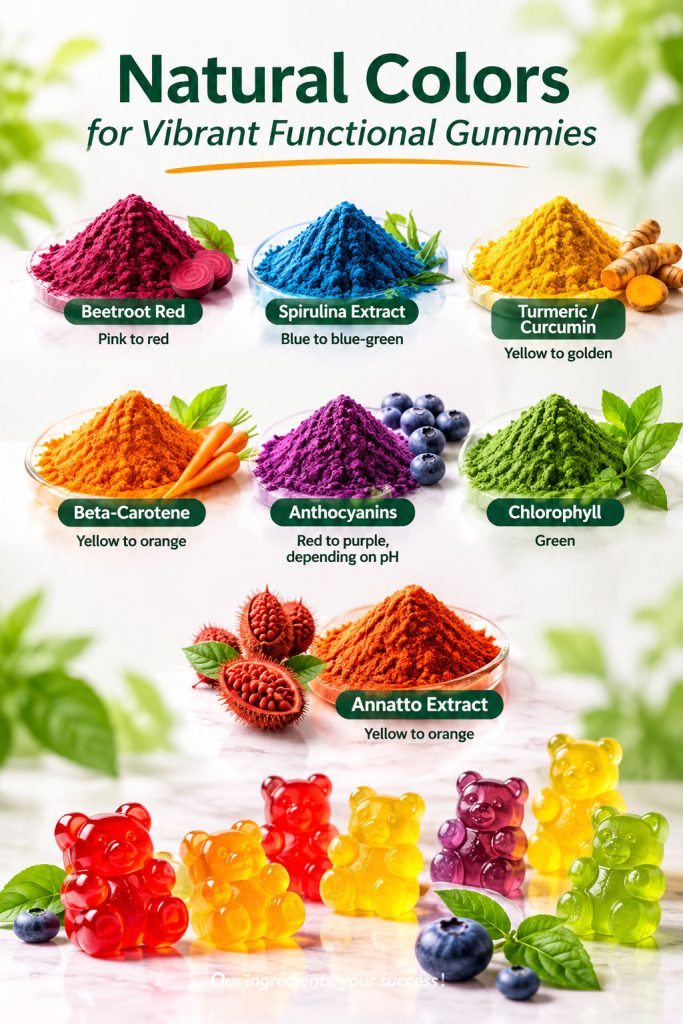
Natural color ingredients provide a variety of color options for functional gummy development.
| Natural Color Ingredient | Typical Color Range | Potential Applications |
|---|---|---|
| Beetroot Red | Pink to red | Berry and fruit-flavored gummies |
| Spirulina Extract | Blue to blue-green | Blueberry and tropical gummies |
| Turmeric / Curcumin | Yellow to golden | Citrus and tropical gummies |
| Beta-Carotene | Yellow to orange | Orange and fruit-flavored gummies |
| Anthocyanins | Red to purple, depending on pH | Berry and botanical gummies |
| Chlorophyll | Green | Plant-based and botanical gummies |
| Annatto Extract | Yellow to orange | Selected confectionery applications |
How to Choose Natural Colors for Gummy Formulations
Natural colors can behave differently depending on the formulation environment.
Manufacturers should evaluate:
- pH Sensitivity: Anthocyanins, for example, can change color depending on acidity.
- Heat Stability: Processing temperatures may affect color intensity.
- Light Stability: Exposure to light can influence color retention.
- Ingredient Compatibility: Other ingredients may interact with natural pigments.
- Shelf-Life Performance: Color consistency should be evaluated throughout the intended shelf life.
For US-bound products, manufacturers should also verify the applicable FDA color additive authorization, specifications, and conditions of use for each color ingredient before commercialization.
5. How to Combine Fiber, Sweeteners & Natural Colors in Functional Gummies
The real opportunity lies in combining different ingredient categories to create complete gummy formulations.
Rather than sourcing each ingredient independently, manufacturers can develop an integrated ingredient system based on the intended product concept.
Application Example 1: Prebiotic Fiber Gummies
Product Concept: Daily Fiber & Prebiotic Gummies
Potential ingredient combination:
- Inulin or FOS – Dietary fiber and prebiotic ingredient.
- Soluble Corn Fiber – Additional soluble fiber.
- Stevia or Monk Fruit – Sweetness adjustment.
- Beetroot Red or Turmeric – Natural color options.
- Gelatin or suitable hydrocolloids – Gelling and texture development.
Key formulation objective:
Develop a pleasant-tasting gummy with an appropriate fiber content, stable texture, and attractive appearance.
Application Example 2: Reduced-Sugar Functional Gummies
Product Concept: Reduced-Sugar Daily Wellness Gummies
Potential ingredient combination:
- Selected soluble fiber – Fiber enrichment.
- Allulose or Erythritol – Bulk sweetening ingredients.
- Stevia or Monk Fruit – Sweetness enhancement.
- Natural fruit flavors and suitable natural colors – Flavor and visual differentiation.
- Gelatin or alternative gelling systems – Texture and structure.
Key formulation objective:
Balance sweetness, chewiness, texture, and processing performance while reducing the reliance on conventional sugars.
Application Example 3: Beauty & Collagen Gummies
Product Concept: Beauty & Collagen Supplement Gummies
Potential ingredient combination:
- Collagen Peptides – Functional protein ingredient.
- Selected dietary fiber – Additional formulation functionality.
- Stevia or other suitable sweeteners – Sweetness adjustment.
- Beetroot Red or other suitable natural colors – Product appearance.
- Gelatin or other suitable gelling systems – Gummy structure.
Key formulation objective:
Develop an attractive collagen-based supplement format with suitable texture, flavor, and ingredient stability.
The examples above are formulation concepts rather than validated commercial recipes. Actual ingredient selection and dosage should be established through technical trials, stability testing, and regulatory review.
6. Beyond Gummies: Expanding Functional Ingredient Applications
Although functional gummies represent an important application opportunity, dietary fibers, natural sweeteners, and natural colors can also be used across a broader range of food and nutrition products.
| Product Category | Dietary Fiber | Natural Sweeteners | Natural Colors |
|---|---|---|---|
| Functional Beverages | Inulin, Resistant Dextrin | Stevia, Monk Fruit | Spirulina, Beta-Carotene |
| Nutrition Bars | Soluble Corn Fiber, Inulin | Allulose, Date Syrup | Turmeric, Beta-Carotene |
| Prebiotic Drinks | Inulin, FOS | Stevia, Monk Fruit | Beetroot, Anthocyanins |
| High-Fiber Bakery | Resistant Starch, Inulin | Allulose, Erythritol | Turmeric, Beta-Carotene |
| Functional Dairy | Inulin, FOS | Stevia, Monk Fruit | Beetroot, Annatto |
| Dietary Supplements | Psyllium, Resistant Dextrin | Stevia, Monk Fruit | Selected natural color ingredients |
This broader application potential enables manufacturers to develop multiple product formats using complementary ingredient categories.
7. Foodchem & Foodmate: Integrated Ingredient and Manufacturing Solutions
Successful functional food development requires reliable ingredients, consistent quality, technical knowledge, and dependable supply chains.
Established in 2006, Foodchem is a leading Chinese supplier of food ingredients, food additives, and feed additives, offering a diversified portfolio and integrated global sourcing and supply chain solutions.
With more than 800 products, a network of over 3,000 suppliers, and customers across 150+ countries and regions, Foodchem supports manufacturers in the global food, beverage, nutrition, pharmaceutical, and animal nutrition industries.
Through its specialized manufacturing capabilities, Foodmate provides manufacturing and application solutions for:
- Gelatin and Instant Gelatin
- Collagen and Collagen Peptides
- Carrageenan
- Konjac Gum
- Functional Ingredient Blends
These capabilities complement Foodchem's broader ingredient portfolio, bringing together dietary fibers, natural sweeteners, natural colors, gelling ingredients, and functional components.
For manufacturers developing functional gummies and other innovative nutrition products, this combination creates opportunities to source complementary ingredients and explore more integrated formulation solutions.

Frequently Asked Questions (FAQs)
1. What are the main ingredients used in functional gummies?
Functional gummies typically contain active ingredients, sweeteners, gelling agents, flavors, and colors. Depending on the product concept, manufacturers may also incorporate dietary fibers such as inulin and FOS, collagen peptides, vitamins, minerals, and botanical ingredients.
2. Which dietary fibers are suitable for gummy formulations?
Inulin, FOS, resistant dextrin, soluble corn fiber, and acacia fiber are potential options for fiber-enriched gummy formulations. Selection depends on solubility, viscosity, taste, processing conditions, and the desired fiber content.
3. What natural sweeteners can be used in reduced-sugar gummies?
Stevia extract and monk fruit extract are high-intensity sweeteners. Allulose, erythritol, and other bulk sweeteners can also be considered depending on the formulation. Combining different sweeteners may help balance sweetness, mouthfeel, and texture.
4. Which natural colors are suitable for gummies?
Potential options include beetroot red, spirulina extract, turmeric, beta-carotene, anthocyanins, and chlorophyll. Their suitability depends on pH, processing temperature, light exposure, and regulatory authorization in the intended market.
5. Can dietary fiber, natural sweeteners, and natural colors be combined in one gummy formulation?
Yes. These ingredients can be incorporated into the same formulation, provided their compatibility is evaluated. Manufacturers should consider ingredient interactions, processing conditions, taste, texture, color stability, and shelf life.
6. What should manufacturers consider when sourcing functional gummy ingredients?
Important factors include ingredient specifications, quality consistency, regulatory documentation, traceability, technical support, supply reliability, and compatibility with the intended gummy manufacturing process.
Partner with Foodchem for Functional Food Innovation
From dietary fibers and natural sweeteners to natural colors and specialized gelling ingredients, Foodchem and Foodmate bring together complementary ingredient and manufacturing capabilities to support the development of functional food and nutrition products.
Whether you are developing prebiotic gummies, fiber-enriched supplements, reduced-sugar confectionery, or innovative functional beverages, we are ready to explore ingredient solutions that meet your formulation and sourcing needs.
Looking for functional gummy ingredients or integrated food ingredient solutions?
Contact Foodchem to discuss your product requirements and explore opportunities for collaboration.
FOODCHEM | Our Ingredients, Your Success!